Sunday, December 16, 2012

Grandpa


My grandpa passed away last week. He was 92, and had a full life. When I was home to visit in August, the emotion I caught from him was one of peace.

I love my grandpa, and miss him terribly. Everyone who has said they are sorry for my loss, I thank you. Everyone who has followed that with “he’s in a better place,” well, that kind of pat answer doesn't comfort me, it kinda makes me mad. It tries to roll my overwhelming  grief into a neat, socially acceptable package that is safe to take in public.  But grief isn't neat, and it isn't comfortable. It pulses from the nagging distraction to full gut-wrenching obsession.  I won’t ever see my grandpa again, and that isn't comfortable.

Really, I don’t want comfort. I want my grandpa back. If I can’t have him, I want to remember him.

I want to grab every memory now, before the business and busyness of daily life crowd them to the back corners of my mind. I want to remember riding along with him when he drove the bank route, listening to him tell me words of wisdom of life, and which small Illinois towns had the best soda fountains.  I want to remember helping him put up hay and take care of the horses.  I want to remember him trying so hard to make things perfect that he’d get angry.  Because Grandpa felt things strongly.

He felt love for Grandma strong enough that he willingly distanced himself from his own family to marry her.  He felt strong enough love for Mom and I to show up with boxes of food the winter Mom had pneumonia so badly she couldn't work.  He felt strong enough love for me to invest in my future in the form of a pony, judging that my high-energy would better off channeled into a pony than let run wild.  He was probably right.

Grandpa gave me so much. He gave me things—my pony, my favorite car (the Delta 88), a jar of pickled beets every time I came to visit. He gave me life lessons—how to work for what was important to me, how to organize my finances, how to be stubborn when needed, and how to forgive and accept.  He gave me his time and his love.  Without these things, I wouldn't be the person I am today. 


I love you grandpa, and I will remember you. 

Friday, November 23, 2012

Inspired by Training


Besides the day-to-day teaching and training that is my job description here at SFD, my calendar gets filled with lots of other activities. I tend to mentally divide those extra activities into 3 categories: things I do to make me a better trainer, things I do to let other folks know I’m a better trainer, and things I do to make other riders better trainers. In the last two weeks, I’ve gotten to do all three, and in that order.

The first event was the Young Dressage Horse Trainer’s Symposium.  This is an annual event in my calendar. Each November Hassler Dressage and Harmony Sporthorses sponsor this amazing event.  In this event, a group of trainers get together with some big-name expert-from-out-of town to discuss the training process of young horses from 3 to 7 years old.  This year we had two expert trainers, Ingo Pape and Oliver Oelrich, who along with Scott Hassler, lead the discussions about the training priorities and challenges at each stage of the young horse’s education.

This event is unique among the clinics I attend in several ways. First, Scott selects a bunch of horses aged 3, 4, 5, 6, and 7 years old.  We see them all, one after another, staring with the 3-year-olds.  Getting the opportunity to see the training continuum of a young horse’s education all at once, and see how their mental and physical maturity is carefully considered at each training stage is really unique.

Second, this symposium is typically led by two like-minded trainers, with them alternating teaching of each student.  After each lesson, the other clinician joins the discussion about the effectiveness of the training approach, and where to go next with each horse’s training. Getting to see two different trainer’s approaches back-to-back really stimulates a lot of thoughtful discussion. 

Third, this symposium is big on discussion.  Horse folks tend to be opinionated, and Scott does a great job of keeping all of our discussions on topic in a positive way.  Most of us trainers do the bulk of our training alone, and getting the chance to discuss training with a bunch of like-minded and like-experienced professionals in a positive, supportive setting is really neat.  This symposium has, in a large part, improved and clarified my approach to developing young dressage horses.  As always, I come away from this event inspired to start my winter training.

The Symposium ended on Saturday night, so on I took Secret to be demonstration riders for DVCTA’s L program.  We rode in groups, with Secret and I in the 2nd level group. The rides and discussion were directed by the instructor, Jayne Ayers.  
The L program is the first step to becoming a USEF Dressage judge, and as an L graduate myself, I feel the need to help out as the guinea pig in their educations.  Plus the candidates and auditors get to see me in action, something they don’t necessarily see at a show. Let’s face it, few people watch dressage shows (because if all goes well, the rides are smooth, flowing, and, especially at the lower levels, dull), so I try to take advantage of any non-competitive opportunities that come up to let auditors to see me train.  Since I ride so many non-traditional dressage breeds, the ribbons at the super-competitive shows in this area really don’t tell the whole story anyway. 

The format, in which we warmed up, then stood around and waited for the instructor to need us to demonstrate different movements, made it tough to present horses at their best.  Plus Secret came out of the trailer feeling pretty frisky.  Secret showed her friskiness as she usually does, by showing the L candidates that shortening the Friesian neck in an attempt to collect the trot really isn’t collection. Happily, she redeemed herself in the canter, allowing Ayers to point out that although Secret didn’t have as much innate elasticity as the fancy imported warmblood in our group, she had just as much collection.

Then, last weekend, I got to go back to Standing Ovation Farm outside of State College, PA, to teach.  This is the 5th time I’ve been up that way, and many of the riders are repeat students. I am starting to see some really amazing changes in the horses and the riders, which makes me super excited, especially since most of the riders are young people.  Who says kids can’t do dressage? Of course they can. They have great feel, and they often have the luxury of parental support to focus on their riding.

The trips to State College are additionally fun for me because I get to help Lindsay Armstrong, head trainer at Standing Ovation. As you probably gathered from the start of the blog, training horses with another trusted trainer is really fun.  Lindsay and I worked with two mares last weekend, and discussed what she feels and what I see, and using both her feel and my eye, came up with a training path to hopefully have both mares show ring ready by spring. 

As cheesy as it sounds, getting to do these three things in this short of a time makes me feel nostalgic of how this whole trainer-student-trainer continuum is supposed to work.  I became the student at the symposium, and was able to then become the trainer in the days that followed.  Getting input on my knowledge from students and other trainers broadens my knowledge, and explaining what I have learned clarifies my thought process on what I know, in essence making me a student of my own teaching, which of course inspires my teaching and training. The circle of trainer-student-trainer creates its own inspiration.  Which is exactly how it is supposed to work.

Wednesday, November 7, 2012

Hurricane photos

We had quite minimal damage, 4 trees down and one section of the roof damaged. We are really thankful, it could have been quite worse.

The calm before the storm. Obviously, the storm preparations
really stressed our horses out.
The tree that stole our power
Seeing the bottom of trees is kinda freaky....


This roof panel was sheared and banging in the storm. This wonderful mare controlled her fear and let me lead her out of her stall in the dark.  It could have ended badly...

Tuesday, November 6, 2012

Horses in a Hurricane, a little late - pics to follow


I wrote this last Tuesday night, when we were on day 2 of no power. Power came back to the barn on Thursday, but not to the house until Saturday, with internet restored yesterday.  Tethering my phone to the computer gave me limited access, but not enough to blog, so here's the better-late-than-never update on how we fared.


With Sandy’s untimely visit, Facebook abounds with photos of the incredible amount of destruction brought by Sandy’s torrential rain combined with the cold front.  With all the hype the media has given this storm (I suspect because reporters are tired of reporting about the election…), many friends and family have checked in to see how we managed on the farm. For readers who keep horses, this post is going to be kinda dull, but for my rare non-horse-keeping readers, who we will now refer to as NHKs, well, this blog is for you. 

For starters, PA is not really known for hurricanes. Usually by the time they get to us, it’s just a nasty storm with a lot of wind. That being said, we have our fair share of weather-related disasters, usually blizzards, and with so many animals dependent on us, we learn to be prepared. 

The big concern for horse owners during a natural disaster, well, really anytime, is colic.  Colic, for the NHKs, is the biggest fear of horse owners. If you, as an NHK, want to see looks of horror and grief, ask your horse keeping friends about it. But be prepared to hear all of the horror stories of all of their horse friends, who of course you haven’t met, who has lost a horse to this horrible thing. Yes, horses really do die from a belly ache. 

Horses, like us, have only one chamber in their stomachs, so are prone to all of the same GI issues as humans – gas pain, ulcers, constipation, etc. But with horses, with ¼ mile of intestine wrapping around inside of their body cavity with just one attachment spot, all GI issues are a bit more volatile. A horse’s intestine, when under stress, can wrap itself around into all kinds of inappropriate knots.  

The best defense horse owners have against colic is hydration and consistency.  The first item, hydration, becomes much more complicated during a natural disaster.

In pretty much any natural disaster, on a farm, loss of power is a given. In the country, this creates a huge problem—no power means no water. For townies, if you lose power, your water still runs. Not so in the country, as wells require electricity.  And horses drink a LOT of water-on average 15 gallons a day.  Hurricanes come with lots of water, so barring trees falling on buildings or fence lines, a minor hurricane can be easier to deal with than a blizzard. 

To prepare for our water shortage, Doug put water barrels at the ends of the downspouts.  All told, we can collect over 300 gallons of rainwater from the barn roofs.  Plus, prior to Sandy’s arrival, he made sure all of the troughs in the fields were full, in case we needed to bucket-brigade from there.  Several times a day, Amy, Maddy or I faithfully make sure all stall water buckets are full to the top, using water from the rainwater catches, so the catches could refill.  Yes, that means I can’t keep my normally high standards of super-clean-or-else water buckets, but it is a hurricane, I do have to let my standards drop a little.

Once hydration is established, horse owners turn their attention to thier next best defense --consistency. Consistent turnout (NHK translation - time in the grassy fields), consistent diet, consistent exercise, consistent temperatures. But natural disasters, by their very nature, disrupt all consistency. So we do our best to keep the things we can control as consistent as possible. 

Turnout isn’t really an option, and because of that, their diets are missing several hours of grazing. But with our indoor arena (NHK translation – huge, warehouse-style room with a sand floor), we can at least keep them moving.  So once chores were done (by flashlight – we have an impressive flashlight collection these days), we got all of the horses in the arena a bit.  The bare minimum was 20 minutes of hand walking, and everyone pitched in to help.  Some of the boarders were still house-bound by downed trees, but the boarders that could make it happily walked, lunged (NHK translation – human stands in the middle holding a really long rope and the horse makes circles around the human), or rode an extra horse while they were at the barn.  All the horses have been super, no loony bucking or goofing off under saddle. On the lunge line or loose in the arena, well, that was another story.  Harry, at the ripe old age of 4 months, is playful on a normal day. His acrobatics in the arena have been a source of much laughter for all of us.

The rain is supposed to stop sometime Wednesday, so hopefully the horses can get back to their normal routine on Thursday.  Peco still has no idea when they will restore our power, so for now the house is running on our generator. It powers the furnace, the house well (we can schlep water over to the horses once the rain catches run out), and the living room outlets.  The barn doesn’t have a generator, which means no lessons once the sun goes down.  So tonight I enjoyed a couple of good beers, had some pulled pork BBQ that Doug had made ahead, and watched the extended version of Lord of the Rings.  Then attempt to tether my phone to my computer to borrow some internet, and post this masterpiece. 

Stay dry, and enjoy your running water for me.


Wednesday, October 10, 2012

Fun times Eight

The Quad Squad.  Thanks Anne Milller for the photo.


As I mentioned in my last blog, Venus and I were members of this year’s DVCTA quadrille team, or the Quad Squad, as coach Anne Miller referred to us. Or the octa-rille, as Doug dubbed us, since there were 8 riders in the pattern.  Then there were 5 flag bearers, so that name doesn’t fit either. . .no matter what you call it, that’s a lot of horses in a 20x60. And a lot of fun.

As a pro, my life is horses. I ride, I teach, and I care for them.  Because the horse business is a high-overhead gig, I have to ride, teach, and take care of a lot of horses to make ends meet. Which means my own horse often gets the short end of the stick.  Last time Venus was in the ring she was 6, mostly because I have had so many client’s horses and sales horses to show.  Which, of course, is a good thing.  But it doesn’t help Venus.

This season two of the horses I compete stayed home to train, so I decided this would be Venus’ year.  Even so, I was having a hard time getting her out often enough for her to learn to relax in the artificial environment we call dressage shows.

When I heard that DVCTA was doing try outs for third level horse/rider combinations for the quadrille demonstration to perform at Dressage at Devon, I tried out. I knew it would be a significant time investment, but since it would also give Venus much-needed mileage, it would be worth it. 

We did several unmounted run-throughs, before and
at Devon, much to the amusement of  spectators.
Thanks Joan Gottier for the photo
Our first practices were pretty hairy. The horses and riders didn’t know each other, and we really needed to trust each other to trot head-long towards another horse’s head, tail, flank, or whatever the pattern required.   Venus, being the only mare and a chestnut, caused a bit of anxiety at first, until everyone realized that she is, in Megan Mendenhall’s words “a lover and not a fighter.” Gradually, the horses and riders became more comfortable with each other, and the pattern began to emerge.

Venus is super adjustable in the trot, and settled quickly into the trot work. But the canter, well, cantering behind one horse with another right behind her definitely jump-started her enthusiasm. Thank goodness Saber, Gert Stearn’s GP horse directly in front of Venus, is a patient sort, and didn’t mind our tailgating.
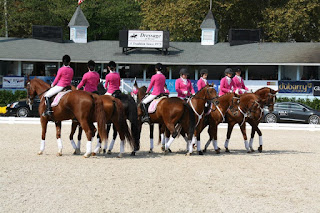
The "after" shot of the movement in the unmounted photo.
Thanks Anne Miller for the photo.
After a few practices of this, I went home and decided it was “now or never” time for Venus’ canter half-halt.  My poor mare was in boot camp.  She did a lot of chestnut mare whining.  When I’d ask her to shorten her canter stride, she wanted to get hoppy.  When I strengthened my seat to get the canter strides rolling and shortened, she’d drop her withers and fall into the trot, or jump forward into a huge canter, leaving me behind.  She really didn’t understand how to make her strides as quick, short and uphill as we needed to keep the spacing, particularly in the left lead.

So one day I decided to let geography help me out. I went out on our big hill and asked her to do canter-walk transitions. The hill kept her from crashing onto the forehand in the walk. After a couple trips up the hill in canter-walk-canter, I could cue a canter half-halt and she would push her withers up while she shortened her stride. Why hadn’t I tried that a year ago???

I took this back to practice, and I would be lying to say it was flawless, but at least it was ridable. 

Then red-mare drama struck. 

First, the silly girl was playing in turnout and wiped out.  Of course she did.  She bruised her right stifle, leaving it hot, puffy and sore, but no major damage.   So I took Mandy to pinch hit for a practice.  My super-pony really wasn’t up for the task, but she gamely did leg yields instead of half passes, and canter-trot-canters instead of the flying changes. The next practice Secret was my catch ride, who, of course, was perfect in every part of the ride, but at 15 hh, was by far the shortest horse in the lineup.  Next to play fill-in was Slingshot, who surprised me by his maturity (he has been home training this season). He cracked both Anne and I up – he has only schooled flying changes a couple of times, but got frustrated by me asking him to canter-trot-canter when all the other horses were swapping leads, so he started to put flying changes on his own. Gotta love that boy.

By Sunday’s dress rehearsal, Venus’ stifle was back to a normal temperature, so she rejoined the group.  Libretto, Melissa’s mount and Venus’ partner, was delighted to see her.  They were really cute at rehearsal.  In quadrille, the ideal is to be so close together that your stirrup clinks your partner’s stirrup. That night, Melissa and I were so close together we could have put our foot in each other’s stirrups. 

Venus and I, Melissa and Libretto.
Thanks Anne Miller for the photo.
Then, of course, Venus had to be dramatic once again.  After her fall, I had taken her off of turnout until after Devon. She is the easiest keeper in the barn, so several years ago I bought her a Stall Grazer, to help make her limited amount of food last longer. Monday night of Devon week, she pulled the thing off of the wall, crashing it onto her left front leg.  Because she is Venus, the leg swelled up like a balloon.  Of course it did. 


Venus has a terrific swell response to any trauma to her body, even from injuries as minor as a scrape. So I have learned to engage the 3-day rule.  If the swelling is there in 3 days, she may have actually damaged herself. If it goes away in 3 days or less, then it’s just her red-mare inflammation response kicking in.  This works well most of the time, but it was Tuesday morning of Devon week, and our first Dressage at Devon experience was scheduled for Thursday night, 2 days away.

After much hang wringing and phone calls, Deb Tsang graciously offered her horse, Oz, to me as a back-up in case Venus’ leg didn’t come around. So I climbed aboard gentlemanly Oz on Thursday night under the lights in the Dixon oval. 

Meanwhile, back at home, apparently Venus realized that she was going to miss the fun.  By Thursday afternoon, the edema in her leg returned to normal and Dr. Crowley gave Venus the all clear.  So we headed to the Devon for Friday’s performance.  She had been locked in a stall for a week, and hadn't made Thursday night’s practice under the lights, but I bravely suited up for Friday’s performance.  I figured, no matter how excited she was, if she kept her head down and her spacing correct, the awesome music would cover all of her fresh-horse playfulness.

My civilized mare!
Thanks Jenn Bryant for the photo
Friday night started well --really well, in fact. Venus felt super and was right with my aids.   Venus and I both really respond to music, so she was trotting in tempo with the music, and I was humming along.    We started cantering to Melissa Etheridge’s “I Run for Life,” a powerfully charged song, and Venus was right with my seat.  Swept by the emotion of it all, I had an uncharacteristically sentimental moment – this was MY horse, my uncivilized 2-year-old was now a big girl, cantering around the Dixon Oval with 7 other horses.  I got a little choked up.

Then I totally forgot the pattern.

Yea, so much for sentiment.

I set up the wrong movement. Then I had to do several really, really strong half-halts to get her back into position, which, she accepted, even with her very fresh, very playful attitude.  We finished the pattern, and I was super proud of my girl. 

Then the applause started. Apparently, my girl can’t take a compliment.  I could feel her getting wound up like a spring. We were supposed to leave at the walk.  Not quite.   Venus and I left at the extended trot.  So much for an encore.

Unmounted for special awards,
just like the hot, spicy CDI
horses ;-). Thanks Jenn Bryant
for the photo.
Saturday and Sunday’s performances also went well. I dismounted for the applause on Saturday, to help Venus sort it out. By Sunday she was more accepting of it, but she still made it very clear that there was no clapping at practice, and therefore clapping during a performance must be wrong. I will be making an applause CD to play in the indoor this winter.  Maybe we’ll need that skill in the future; you never know when 12 other riders will need me again.

 A special thanks to Unionville Equine for sponsoring the team. This whole experience was truly special.


Thursday, September 13, 2012

That time of year...

Yes, every year about this time I post a blog about how things get a bit crazy...and this year is no exception.

On top of our normal show craziness, I made DVCTA's quadrille team, that will perform at Dressage at Devon, with Venus. The drill team has been tons of fun and amazing for her. She has learned to stay with my aids no matter what--horses beside her, horses in front of her, horses chasing her, horses coming straight at her, or horses waving scary flags. She is such a brave girl. I am a ridiculously a proud mom.

As good as it has been for her, quadrille plus showing has been rough on my schedule. Eclipse, who has been competing like mad to get his scores in for his year-end awards, and Venus both routinely go to the bank with me.  My bank actually has a drive-through large enough for my truck and 2-horse trailer. Who knew?

Everyone has been showing well.  Secret returned from her training break with a whopping 67.8% at 3rd 3, so that was time well spent. Eclipse has been a bit inconsistent at PSG, and after getting the vet involved, we have started him on omperazole. Hopefully that will bring some consistency to his show numbers.  Pee Wee and Mandy, the two sales horses have been really, really consistent every outing. Flash, the super-power pinto, is getting back in the ring this month after loosing most of the show season healing from an injury back in Feb.  Her owner and I are both pumped that she beat the odds and made it back.

I have made my regular trips to MD for Scott's help, caught an odd clinic or two here and there, and somehow, in all of this stress, managed to keep my enthusiasm up, which is no small feat. That is helped in no small part by my super support, both at home (I owe Doug big time...) and in the barn, and by the steady progress of my mounts. I had Amy shoot some video this week, and I was pleasantly surprised by the improvements in their balance and consistency.  Nothing is as inspiring as progress.

Plus, an additional inspiration, I was interviewed by Amber Heintzberger of USDF Connections magazine for an article about finding appropriate adult amateur dressage mounts. In the article, the reporter highlighted my comments about non-warmblood dressage mounts, along with a photo of Eclipse and me. The article ran in this month's issue.   Isn't that awesome?

On that note, I'm off to pack the trailer. Venus and I are are accompanying Alexa and Ockie at NEDA's Fall Festival in Saugerties this Friday and Saturday. I get home on Sat night, then take Pee Wee  and Joyce and Pikasso to a schooling show Sunday, squeeze in a few lessons, then quadrille practice in the evening, where Mandy will pinch-hit for Venus who will get a well-deserved break after the show.

No rest for the wicked, or is it the weary? I've heard it both ways...either way, no rest until the end of September.


Sunday, August 12, 2012

How I Spent my Summer Vacation


Abigail Lipow has spent the summer as SFD's working student. In the spirit of all of those annoying 4th grade essays, I asked her to describe her summer in her words. I have been really pleased with her improvements in the saddle, and in reading this, I think she is too.  -- Ange


by Abigail Lipow

Last year, I had no idea what I was going to do with my summer. In fact, summer wasn’t even close to being on my radar, as we Penn Staters had enough to deal with. I had vague thoughts of getting an internship somewhere and having that as my whole summer experience, which would be good work experience for the future and graduate school. Way back during the fall semester, all of my friends were getting confirmation on their study abroad programs, and I was kind of stuck. I had gone abroad and traveled a lot in high school, and studying abroad didn’t really appeal to me then. However, I was especially jealous of my friend who studied in Italy for the entire semester, and then got to stay another month and travel around Europe after her program ended. 

I also knew that I needed help with my riding. I took the place of our first level rider on the Penn State IDA team after she graduated in 2011, and our other first level rider went on a study abroad in Britain. At the time, I had been coming back from taking a two year hiatus from dressage and doing hunters on the IHSA team at school. I was more of a training level rider, and I admit it, if I had stayed in that level I probably could have swept it. I could ride a first level test, but it definitely wasn’t pretty and the girls I was up against were solid first level riders, some of them most likely schooling second. I (or rather, my mother) found that Ange had moved into the old Banbury Cross when I decided I was going to quit hunters (because, really) and go back to my first love, dressage.

I had really only ridden with Ange for about a month during my school breaks and I asked if she maybe had room for another working student for the summer, since my internship prospects were looking sort of grim, even though it was too early to tell at that point. After I took over the presidency of the team in the beginning of the spring semester, we started talking about bringing in a clinician and I immediately thought of Ange, considering that our current coach is more of a cross-country rider herself.

Ange agreed to come up to State College, and the clinic was a hit with the local Pony Club. During my lesson, she said that there was an opening for the summer as her working student, for which I am definitely grateful. Even though we still had a month of school left, including finals (ugh), I wanted to come home and start right away. Plus the weather in State College was kind of icky that month, and I think we all needed a break from the news vans crowding campus.

This summer has been a blast. Where else can you be around horses for hours every day? An internship in the city was certainly not going to give me that, unless you count the carriage horses. The first thing Ange did was strap me into the Unisit, forcing me to sit deep in the saddle and use my seat, which is something the hunter deep inside of me still cringes at. I think after a few rides in that I could feel every individual abdominal muscle, and soon I could sit Clyde’s springy trot, without the Unisit. At the same time, I was learning about how much work it is to care for a barn, painting gates (which look awesome by the way), cleaning stalls, and much more. I even got to visit Hassler Dressage at the beginning of the summer, which I’m still in awe of.

My riding has become a million times better, and not only do my abs not hurt that much anymore after I ride, but the “wow, he did what I asked-oops, I stopped riding” has almost gone away. Sort of. We’re still working on those chicken wings. I have a few more weeks to cram in what I can before school starts at the end of August and set the mental attitude that I can make a difference in whatever horse I’m riding.  As Ange calls it, this is my “crash course”. I can now make round ten and twenty meter circles, and make square corners. Sometimes I can even get Karison to stay round and have some power without getting all scrunched up in the saddle.

The little hunter leg squeezes have mostly gone away, and leg bumps have mostly taken their place. I’ve still got more work to do on leading with my seat, not following, but hey at least I can sit now without posting at all. I’ve learned make circles with my seat and leg, not my hands, while I still need to work on having quieter hands. I also need to remember not to go hunter when I feel uncomfortable. While there’s still quite a bit for me to work on (as we’re all always learning), I feel like I’ve accomplished my riding goal for the summer: be competitive at first level in the fall. So thank you Ange, and everyone else, for giving me an awesome summer. And don’t worry; I’ll be back for some touch ups in the fall.